Teachers and students will also find many useful links and information on the For Teachers page and on the Grants page. In addition, Advanced Biofuels USA has prepared PowerPoint presentations available in the Biofuels Basics section on the PowerPoint Presentations page.
For more examples, click on categories such as Education and Teacher Resources along the right margin of the web site. And, subscribe to our free monthly newsletter.
Websites with educational materials about biofuels and advanced biofuels
- Biofuels for Europe In order to have a science-based, understandable source for information on biofuels, a selection of biofuel experts from the academic world have summarized the latest science on key biofuels issues such as the impact on food and land, GHG emissions, energy security and cost-efficiency and have presented it on this website, “Biofuels for Europe”.
The contributions are documented with facts and figures including references to existing reports and studies that should be easily understandable.
In addition, via the Biofuels for Europe website, the opportunity to ask contributing academia questions on biofuel-related science issues is available.
This website is supported by four companies: BP, Novozymes, Scania and Shell and is managed by a third party independent consultant, Meghan Sapp, who has held roles such as Senior Editor for Biofuels Digest, Editor of Sugaronline.com and Secretary General of Partners for Euro-African Green Energy.
- The Sun Grant BioWeb is a non-commercial, educational website that provides current information about using biomass resources for bioenergy and bioproducts. This site is designed to help you understand:
- What biomass is, where it is, and how much is available
- The ways it can be converted to biofuels, biopower, and bioproducts
- The current state of biomass technology, research, production & use
- Biomass economics and policy
All BioWeb content is contributed by experts in their fields and vetted through an academic peer review process. Use the left bar links to navigate this rich source of peer-reviewed information related to biomass and its utilization.
- High School Chemistry using Biodiesel (University of Idaho)
Eight chemistry labs are designed by the scientists and researchers at the University of Idaho's Biological Engineering Department to be used in a high school setting. These labs can also be used as individual labs to teach various concepts commonly encountered in high school curriculums. To view a summary of all labs suitable for incorporating in high school curriculums, Click here.
Each lab has a companion video demonstrating how to conduct the lab safely and accurately. Learning outcomes of each lab and titles are given below:
- National Science Foundation. Green Gasoline: A Renewable Petroleum Alternative From Plants: Includes fact sheets, videos, highlights from NSF panel discussions.
- Algae Industry Magazine 20-part primer in understanding the basics and current state of algae biofuels
- National Energy Education Development Project includes Curriculum Resources by subject matter. Although some information about renewable fuels in included, the emphasis is on fossil fuels.
- Ethanol-Blended Fuels: This curriculum on ethanol and its use as a fuel was developed by the Clean Fuels Development Coalition in cooperation with the Nebraska Ethanol Board. This material was developed in response to the need for instructional materials on ethanol and its effects on vehicle performance, the environment, and the economy.
As a renewable alternative energy source made from grain and other biomass resources, ethanol study serves as an excellent learning opportunity for students to use in issue clarification and problem-solving activities. Ethanol illustrates that science and technology can provide us with new products and new uses for products. This curriculum provides teachers and students with the basics needed to understand the use and production of ethanol. After sorting out the facts, students can reach their own conclusions about using ethanol as a fuel in their vehicles–and if it is in the interests of the state and nation to do so.
The curriculum begins with “Module 1: Introduction to Ethanol.” This module contains basic challenges, history, and reasons for alternative fuels, especially ethanol. This curriculum may be taught as a unit or topics may be integrated into other units of instruction. It is suggested that Module 1 be used to lay the groundwork for any number of the remaining modules.
Goals and Objectives This curriculum was written to assist those teaching in grades nine and up. It is applicable for use in science, social studies, mathematics, statistics, vocational agriculture, driver education, tech prep, industrial education, automotive technology, and language arts courses. After completion of this curriculum, students will be able to:
a. Identify the process of converting grain to ethanol
b. Identify the variety of biomass/cellulose sources from which ethanol can be produced
c. Identify the energy relationships between science, society, and agriculture
d. Determine benefits and concerns of using ethanol in motor fuel
e. Develop skills in problem solving and personal decision making
- Renewable Fuels Association's Students and Teachers Pages
- Bioenergy Science Center’s Students and Kids page
- Great Lakes Bioenergy Research Center
The materials on this website were developed by teachers and professional educators associated with the Great Lakes Bioenergy Research Center with input from our scientists. The materials are designed to engage students in learning about science and engineering challenges associated with producing sustainable biofuels. All materials are aligned with the Next Generation Science Standards (NGSS) and designed to fit within the curriculum of standard K-16 science courses.
Materials include investigations, shorter stand-alone activities and readings, as well as longer integrated units. Use the sort and search features to find materials that meet your needs. Alternatively you can browse a list of our materials sorted by NGSS Performance Expectation or browse the NGSS performance expectations for each activity.
For additional bioenergy labs and activities developed through participants in our Research Experience for Teachers program, visit the RET Projects page.
To download the activity: Click on the title of the activity or the "read more" link to navigate to a new page, where you will see a "download" link. READ MORE
- Ohio 4H
- Energy Information Administration's Biofuels Basics
- National Renewable Energy Laboratory Biomass Energy Basics
- Forestry Biomass for Cellulosic Fuels
- The ABCs of Biofuels includes a glossary
- Summary of biofuels history at National Geographic
- Learn about Biodiesel and Clean Diesel Developments
- Biodiesel Basics including a section about warranties
- Biodiesel Basics, very basic with links to other resources
- Biodiesel Production in English or German
- Parents’ and Teachers’ Pages on Renewable Energy and Conservation
- Links to More than 350 Lesson Plans and Activities on Energy Efficiency and Renewable Energy for Grades K-12. Links to Lesson Plans for Grades K-12
- Science Fair Projects
- Ohio Soybean Council/GrowNextGen.org
- Open-Source Biofuels Educational Material. 16-week course dates to 2006.
- Michelin GreenX Challenge booklet
- National Biomass Producers Association Biomass FAQs
- Aviation Transport Action Group includes Beginners' Guide to Aviation Biofuels
- Piedmont Biofuels, includes Curriculum with focus on biodiesel
- State Bioenergy Primer from National Renewable Energy Lab and US EPA
- The Ethanol Minute is a national radio show broadcasting interviews with experts from all walks of life including elected officials, celebrities, energy and environmental experts, and businessmen and women.
- Energy 101, a series of YouTube videos created by the US Department of Energy to introduce and inform citizens about what is being done to develop alternative sources for our energy needs. See the biofuels video and the algae-to-biofuels video.
- Agricultural Energy teaching materials for instructors. Focused on harvesting energy from farms while considering cost and efficiency. Suited for High School and Higher Education...and completely FREE to download and use for use in your classroom or anywhere else. All files are in PowerPoint (.pptx) format. The curriculum designer on this project was Tim Benedict who is from a rural farming community in Illinois. Tim holds a Masters of Environmental Studies from Evergreen State College in Olympia, Washington. He would be pleased to receive feedback about the curriculum for future revisions at agenergy@ateec.org
- Southeastern Partnership for Integrated Biomass Supply Systems / University of Tennessee Learning Materials page includes:
The UT conversion team has created an education module that pertains to the use of biochar as a soil amendment. In this module, students will use biochar in an effort to determine what affect it has on the growth of various types of seeds. Students will plant seeds in the presence and absence of biochar and monitor the growth of the plants for a period of time. Comparisons in crop yield will demonstrate the effects of biochar as a soil amendment. The module is designed to align with Common Core and Next Generation Science Standards. This module is suitable for middle and high school students.
This eight-hour online course is designed to prepare agriculturists to work with farmers as employees of a bio-refinery to provide its feedstock needs. Course topics include site selection, soils, drainage, fertility, varieties, weed control, selecting growers, contracts, production systems and other switchgrass production issues. Course instructors are specialists from Auburn University, University of Tennessee, University of Kentucky and Genera Energy. http://www.aces.edu/~hallmah/
Biomass Composition and Conversion
Chemical Compositional Analysis of Lignocellulosic Biomass
Pathogen Identification Using PCR
Pretreatment and Saccharification of Lignocellulosic Biomass
Agrobacterium - From Plant Pathogen to Biotechnology
Enzymes for Biofuels Production

Stanley E. Manahan This website contains information and PowerPoint presentations for two university-level courses: (1) A course in environmental/toxicological chemistry and (2) a course in fundamentals of green chemistry including sustainable science and technology. Additional materials pertaining to environmental chemistry, sustainability science and technology, and related areas are available on the following websites:
https://sites.google.com/site/manahans1/
https://sites.google.com/site/environmentalchemistry1/
https://sites.google.com/site/manahanse/ READ MORE
You and Your Science Fair Project: For Teachers, Students, and Parents A science fair project is best described as a basic demonstration of how the world of science works through research, observation, and experimentation. The main objective of the projects is to analyze a scientific occurrence with an investigation or to solve a problem with an invention. Science fair projects generally are assigned to children of all ages by their school teachers, giving them a great opportunity to learn about science outside of books and homework. Provided below is a guide to easily make a winning science fair project for any level science class. READ MORE
B20, TRANSESTERIFICATION, FAME — HERE’S YOUR BIODIESEL DICTIONARY Like any industry, biodiesel has its own jargon that can be confusing to a newcomer. Don’t let this be a barrier to learning more about how biodiesel could benefit your operation with its lower emissions, strong performance and competitive price. Here are definitions of common terms in the biodiesel industry. From Renewable Energy Group
Websites with Academic/Technical/Scientific Papers and Presentations
See also the Government Resources page.
- Scripps Photobiology Group
- Biomass 2010
- Biomass 2009
- Biomass 2008
- Microalgal Biofuels: A Brief Introduction by John R. Benemann
- CNA Analysis and Solutions
- The Energetics of Ethanol (Institute for Local Self-Reliance, New Rules Project)
- New Fuels Alliance Selected Studies, Reports and Other Information
Dynamic Maps, GIS Data and Analysis Tools
The Dynamic Maps, GIS Data and Analysis Tools Web site provides dynamically-generated maps of renewable energy resources that determine which energy technologies are viable solutions in national and international regions. For a quick snapshot of U.S. resource maps for various renewable energy technologies, including US biomass resources, access the Renewable Energy Technology Resource Maps for the United States PowerPoint presentation on the NREL map web site.
This site also provides access to the NREL FTP site where you can download data and Geospatial Toolkits. The National Renewable Energy Laboratory's Geographic Information System (GIS) team analyzes wind, solar, biomass, geothermal, and other energy resources and inputs the data into the GIS—Geographic Information System. Read more about NREL's GIS team and the map server that creates the dynamically generated maps. For help with the maps you can access a video tutorial that will show you how the dynamic map sites work.
EPA's Renewable Energy Interactive Mapping Tool (KMZ) (2.2MB), a Google Earth KMZ file, makes it possible to view EPA's information about siting renewable energy on contaminated land and mining sites, alongside other information contained in Google Earth. It enables the user to search by renewable energy type or by contaminated land type. In addition to the site's location, it also provides: site name and identification information; EPA Region and program managing the site; a link to the site's cleanup status information; and specific acreage and renewable energy resource information.
International Energy Agency earlier this year completed its mapping of global second-generation biofuels demo plants and projects. You can search by type of plant (biochemical, thermochemical or hybrid), scale (pilot, demo or commercial) and status (planned,on hold, under construction, under commissioning, or operational). Each individual entry includes data on the project name, location, technology, output, facility type, total investment and a technology brief on each project, plus contact information and project photos.
NREL also has an online interactive mapshowing the locations of 2,000+ E85 fuel stations around the country. The map plots the location of ethanol plants as well as E85 stations, and includes propane, hydrogen, and other alternative fuel locations.
Locate biodiesel plants in the US and Canada on Biodiesel Magazine's interactive map.
Currently, large efforts are dedicated to the production of biofuels from lignocellulosic raw materials. While only few production facilities are operational yet, many projects are under construction or planned. But which are the companies involved, where are production facilities under construction, and which technologies will be applied? In order to answer these questions, IEA Bioenergy Task 39 has collected data on pilot and demonstration projects and displays the results in a web-based, interactive map.
The US Department of Energy's National Renewable Energy Laboratory's BioEnergy Atlas maps allow you to compare and analyze biomass feedstocks, biopower and biofuels data from the U.S. Department of Energy (DOE), U.S. Environmental Protection Agency (EPA), and the U.S. Department of Agriculture. It iincludes a BioPower Atlas and a BioFuels Atlas.
The Sustainable Energy and Climate Change Initiative (SECCI) and the Structured and Corporate Finance Department (SCF) of the Inter-American Development Bank (IDB) have created the IDB Biofuels Sustainability Scorecard based on the sustainability criteria of the Roundtable on Sustainable Biofuels (RSB). The primary objective of the Scorecard is to encourage higher levels of sustainability in biofuels projects by providing a tool to think through the range of complex issues associated with biofuels. Since the scientific debate around these issues continues to evolve, the Scorecard should be seen as a work-in-progress and will continue to be updated and revised as needed.
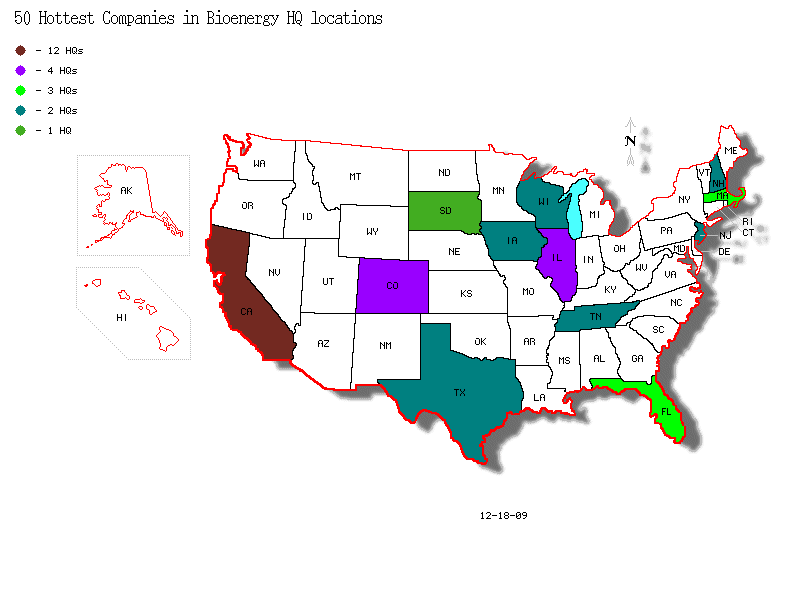
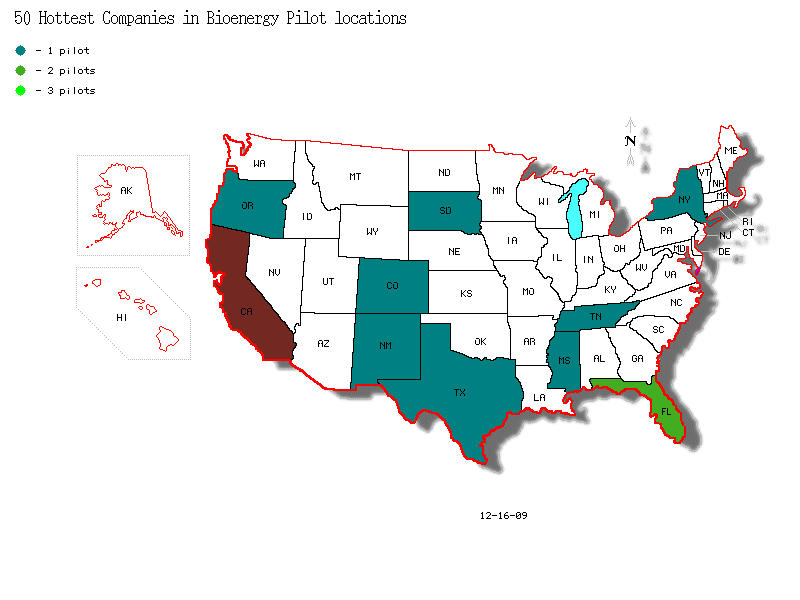
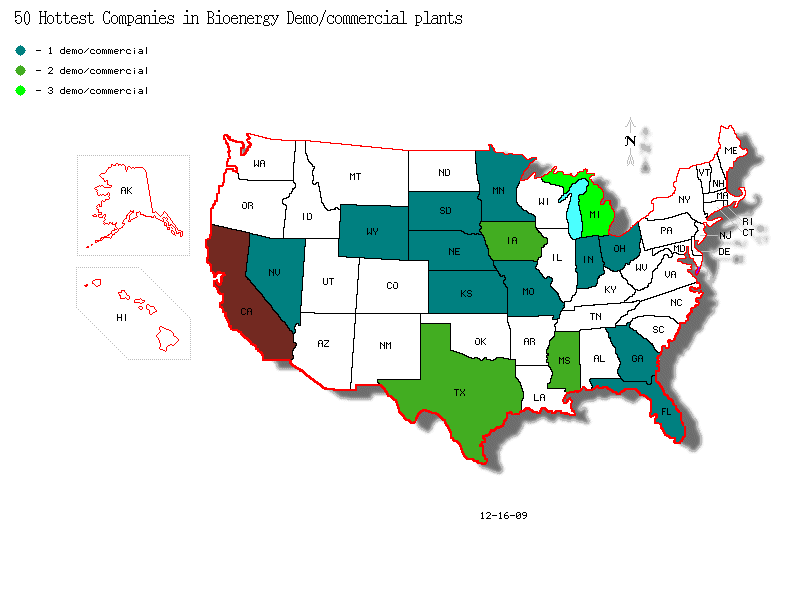
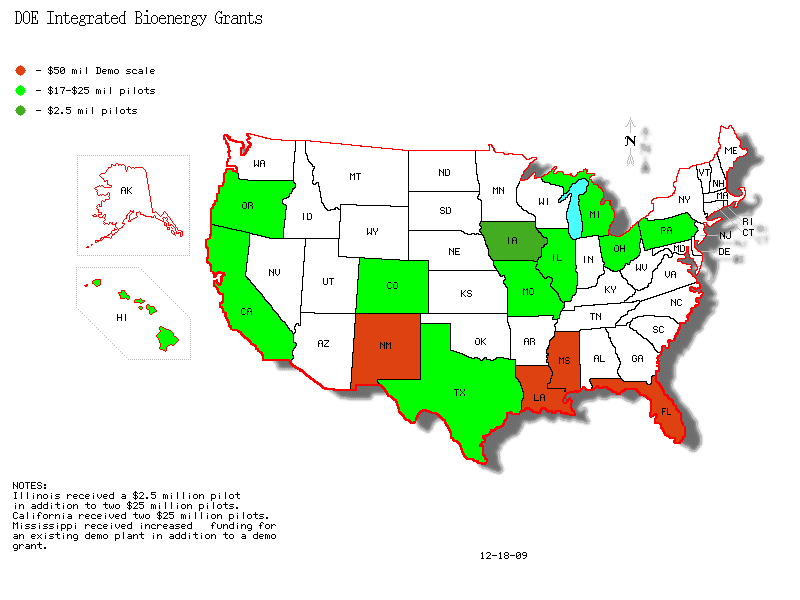
Biofuels Digest has prepared several maps which help to visualize the distribution in the US of advanced biofuels development. Maps include:
1. Locations of the companies in the 50 Hottest Companies (2009) in Bioenergy. Free download.
2. Locations of pilot-scale projects of the 50 Hottest Companies (2009) in Bioenergy. Free download.
3. Locations of demonstration-scale and commercial-scale projects of the 50 Hottest Companies (2009) in Bioenergy. Free download.
4. Locations of pilot and demonstration-scale projects that received support in the $564 million Department of Energy IBR grants, announced December 2009. Free download.
The Renewable Energy Policy Network REN21 launched its Renewables Interactive Map (beta-version). The Map contains a wealth of information on renewable energy, including support policies, expansion targets, current shares, installed capacity, current production, future scenarios, and policy pledges. The REN21 Secretariat collects the information from various reports, databases, news announcements, specific enquiries, and other sources.
Designed as a central access-point to renewable energy information, the Map is dependent on the knowledge contributions of many organisations and individuals in the renewable energy community. REN21 strives to cite the sources for all the information presented, so that users can access further information directly.
As the network of the renewable energy policy community, REN21 has provided authoritative information for several years, in particular through its Renewables Global Status Report. As a new tool for REN21’s knowledge management, the Renewables Interactive Map is designed to track more closely the dynamic development of renewable energy policy-making and market development, and to provide disaggregated information for specific countries and technologies.
A tutorial video provides guidance on how to use the Map.
Websites with Conference Lists
Penn State Institute of Energy and the Environment. Browse upcoming national and international energy and environmental conferences: Conferences are listed chronologically by date with the most recent listed first.
Websites with Competition Information
Shell Eco-Marathon challenges high school and college student teams from around the world to design, build and test energy efficient vehicles. With annual events in the Americas, Europe and Asia, the winners are the teams that go the farthest distance using the least amount of energy.
.jpg)